Bhagat Mandal: When Farming Advice Comes Within Reach
आश्विन २७, २०८३ | Nadima Karki
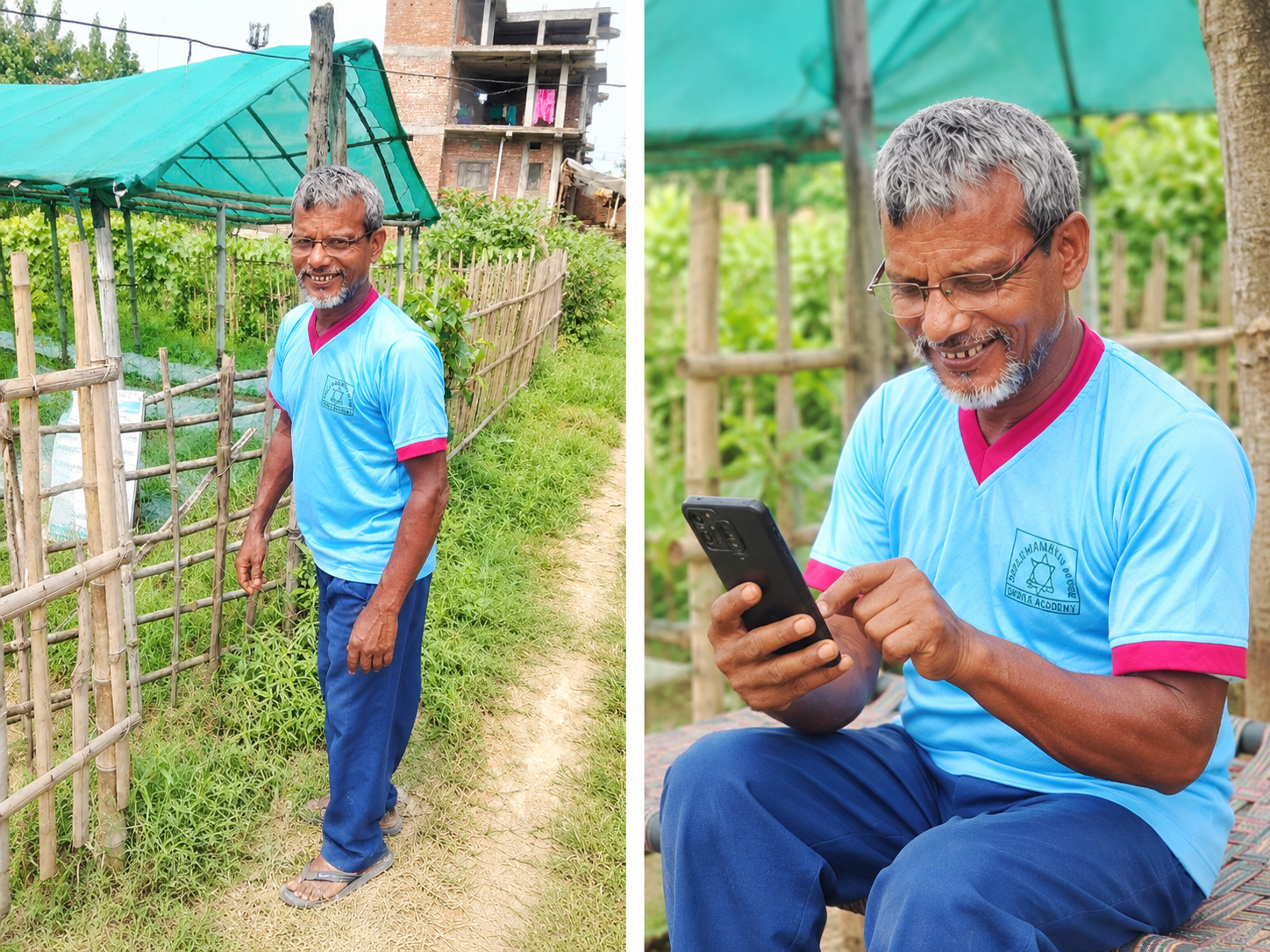
For years, the hardest part of farming for Bhagat Mandal was not the work itself. It was uncertainty. When a crop looks different, the weather changes, or an input is needed, Bhagat struggled to access the right assistance to solve these issues.
Living with a physical disability made that uncertainty even heavier. The help he needed was often out of reach at the very moment he needed it.
Today, Bhagat has solutions in the palm of his hand: he can connect with GeoKrishi.
His journey is a story of how timely agricultural information and services can make farming easier and how digital access can help farmers, including those living with disabilities, take greater control of their farming decisions.
A Farmer Who Kept Moving Forward
Bhagat Mandal, 47, is a farmer from Janakpurdham-15, Dhanusha District, Madhesh Province, Nepal. He is also the president of Apanga Samajh Sewa. He has lived with a physical disability since childhood as a result of polio. He lives with his wife, two daughters, and a son, and farming is a family effort. His father, wife, and son support him with fieldwork when needed.
Bhagat owns 15 kattha (about 0.5 hectares) of land where he grows rice and leases another 12 kattha (about 0.4 hectares) for vegetable production. He seasonally grows brinjal, okra, bottle gourd, bitter gourd, cabbage, and cauliflower. He also maintains a nursery where he is currently raising tomato seedlings. Because farming alone does not always bring in enough to meet the household's needs, the family also takes on tailoring work for additional income, but farming remains their main source of livelihood.
For Bhagat, farming has always meant learning, adapting, and making decisions. Making those decisions well depends on having the right information at the right time.
From Uncertainty to Having Someone to Ask
Until two years ago, Bhagat did not have a reliable source of agricultural information. He was often unsure which crops suited different seasons and what to do when pests or diseases appeared. Changing and less predictable weather also made farming decisions more difficult. Because travelling is not easy for him, it was usually his wife who made the trip to the agrovet for crop advice or inputs, on top of her share of the farm work, the tailoring, and the household chores. Each trip added to an already full day for her.
Things began to change when he joined a community training where Bikash Sah, GeoKrishi field officer, introduced farmers to the GeoKrishi Farm App and its agricultural advisory services. Through the app, farmers can receive weather forecasts to plan field activities such as sowing, irrigation, and spraying; send photos of affected crops to agriculture experts through the Crop Health feature and get advice on managing pests and diseases; access crop-specific production information; and order agricultural input for delivery to their homes. Together, these services help farmers make timely and informed decisions that reduce crop losses and improve productivity.
At the time, Bhagat did not have a smartphone. He wanted one but could not afford to buy it. His son later got a smartphone, and Bhagat now uses it to access the GeoKrishi Farm App.
Bhagat was not immediately convinced. At first, he had less confidence in the information provided through the app. But he continued using the service.
The Crop Health feature became particularly important. One day, Bhagat noticed that the leaves on his tomato plants were turning brown. He had seen similar problems before and initially went to the agrovet, hoping to find something that would protect his crop. He applied the product he purchased, but the problem continued to worsen. Unsure of what else to do, he took a photo of the affected plants and sent it through the GeoKrishi Farm App. An agriculture expert reviewed the image and sent him advice on how to manage the disease, late blight. Bhagat then returned to the agrovet, this time looking specifically for the recommended input. As the condition of his plants gradually improved, he began to trust the advice he received through GeoKrishi and used the app more confidently when problems arose.
Crop Health eventually became the GeoKrishi service he uses the most.
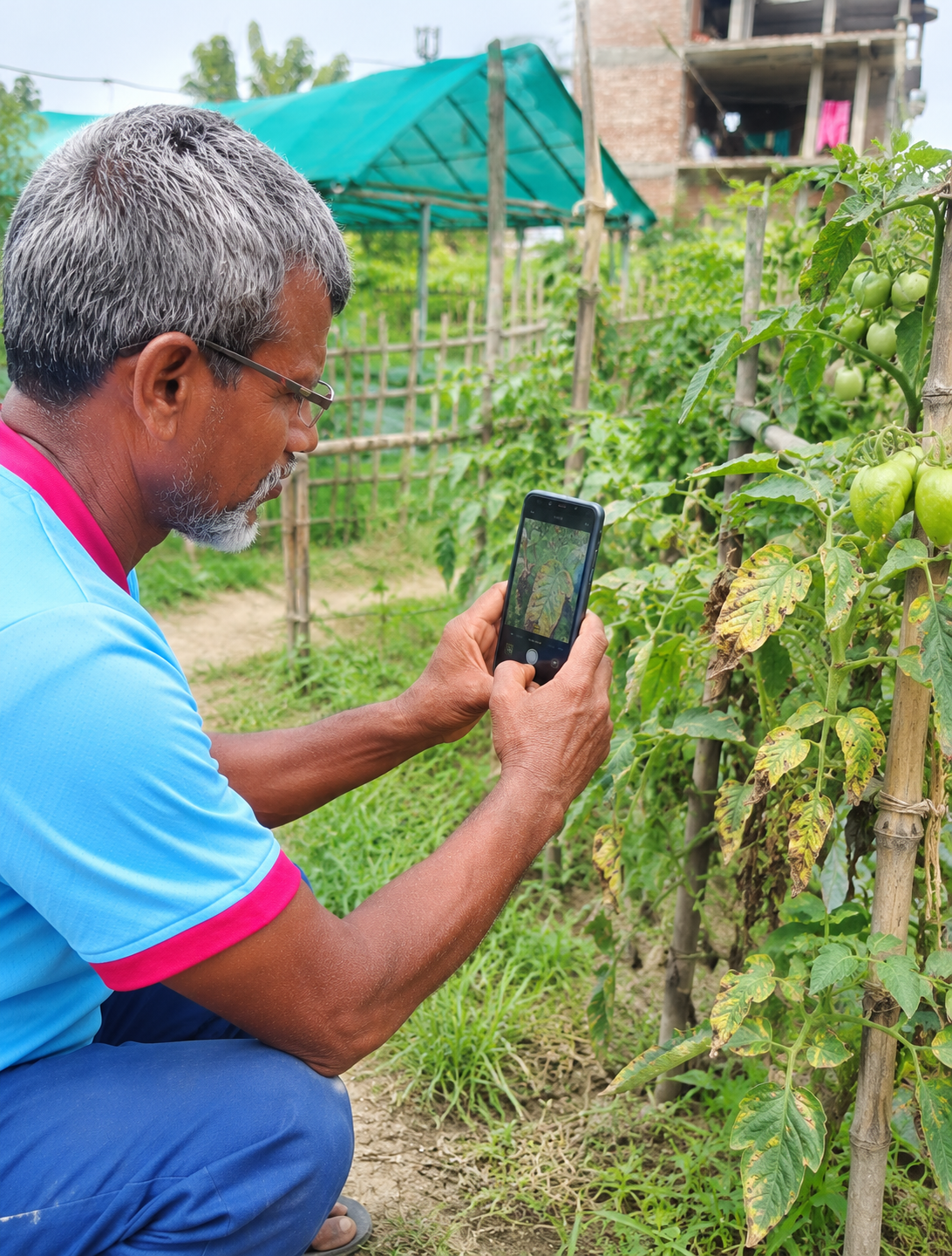
Bhagat also participated in further GeoKrishi training and attended webinars organized by GeoKrishi on different production plans where he could learn and directly ask questions to agriculture experts as well. Reflecting on those early interactions, Bikash says:
“Bhagat was very active during the training. Whenever he had confusion, he would ask me and try to understand how he could use the service on his farming. He also participated in webinars. I feel very happy that GeoKrishi has been able to support him and provide the services he needs in a timely way.”
When a Crop Problem Appears
One of the biggest changes for Bhagat is how he responds when something goes wrong in his field.
What matters to Bhagat is being able to get the right support at the right time.
Instead of spending time searching for advice or travelling simply to find out what might be wrong, he can seek support through his phone and act on the recommendation he receives. Previously, a visit to the agrovet for crop-related advice took around 2 hours, a trip his wife usually made for him. Now, Bhagat spends around 5 minutes sending the problem to an expert through GeoKrishi and receives advice within an hour or two. As an illustration, if this happens 4 times in a season, the family would save more than 7 hours.
He also uses GeoKrishi for crop information and weather forecasts, helping him plan his farming activities with more information than he had before.
For Bhagat, the phone has become a practical connection to agricultural support.
From Visiting the Agrovet to Ordering from Home
The change also extends to agricultural input.
In the past, every agricultural input meant another trip to the agrovet. Today, he can place an order through GeoKrishi and have the input delivered to his home.
When he needed cauliflower seed, he asked GeoKrishi for recommendation. The platform suggested Super White Top variety, which he ordered with the help of GeoKrishi field officer Bikash Sah.
On another occasion, he ordered a spray machine and received it within two days.
For Bhagat's family, this matters more than convenience. Seeds, tools, and other inputs now come to the doorstep, so his disability no longer limits what he can get for his farm, and his wife no longer has to set aside farm work, tailoring, and household chores to fetch them.
As he puts it:
“GeoKrishi guided me, and that's how I've been able to keep my farming going.”
When Access Becomes an Enabler
Bhagat's story is also about inclusion.
He continues to farm, learn, participate in training, and use agricultural services. GeoKrishi has helped make some of these services easier to access.
That access has helped build his confidence.
Bhagat reports changes in his crop production and in the way he manages pest and disease problems.
“GeoKrishi has been a boon for farmers with disabilities like me,” he says.
His experience has also been noticed by people around him. Neighbors have seen how he uses GeoKrishi and became interested in trying the service themselves. Friends living with disabilities have also followed his example.
“I am one example,” Bhagat says. “GeoKrishi should give training to other farmers with disabilities too.”
His Message for the Future
Bhagat believes that GeoKrishi has the potential to assist farmers at a much deeper level in both production and marketing.
He sees soil testing as a natural next step. Bundled with the advisory services he already uses, soil-testing services could support more precise, data-driven decisions to enhance his production, and he hopes such services can be made widely available to farmers like him.
He also sees more potential in the input delivery service. His orders generally reach him within about a week, and sometimes sooner, as with the spray machine, but he wishes deliveries could be even faster so that inputs arrive exactly when his crops need them.
His vision extends to women farmers as well. Women in his area have their own farmer organizations, or Mahila Krishi Samuha, and he believes the services provided by GeoKrishi should be extended to them as well.
From Access to Action
Bhagat's story began with uncertainty.
Which crop should he plant? What should he do when a disease appears? Where should he find the right input?
Today, the process can be different.
A disease appears. He takes a picture. He sends it to GeoKrishi. An agriculture expert responds. He follows the advice.
For Bhagat, digital agriculture means having information, advice, and agricultural services within reach.
Bhagat's story shows what can happen when technology becomes an enabler rather than another barrier.
And for him, the next step is clear: more farmers, especially farmers who may face barriers to accessing agricultural services, should have the same opportunity to move forward.
For years, help was a journey away. Now, it is just a tap away.
This story is based on an interview with Bhagat Mandal conducted on 18 September 2026 under ICIMOD HI-GRID project. He gave his consent for the interview, its audio recording, and the publication of his story.